
“The noblest motive is the public good.” ~ Virgil
Acknowledgements: First appeared in the Pennsylvania Municipal League “Municipal Reporter”, April 2025
Civic engagement is defined by engagement in activities which improve one’s community or address wider social issues. As a non-profit, health pool formed and operated by its public entity members, The Delaware Valley Health Trust (DVHT) embodies a purpose driven commitment to community and the ability to drive innovative improvement through municipal cooperation for the common good.
Formed in 1999 by local government, for local government, DVHT has delivered unparalleled results for its direct (165 municipal entities and over 25,000 members) and indirect stakeholders.
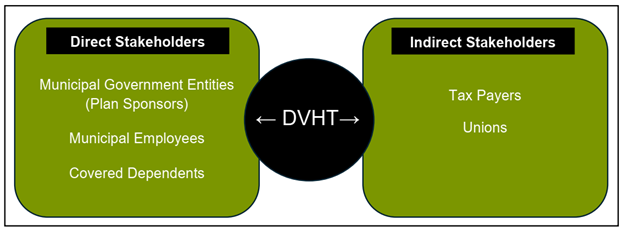
In creating an alternative to commercial carriers and the broker-driven health insurance market, DVHT members opt-out of the traditional insurance market and make a commitment to the other participating public entities in the pooling of risk thereby creating an alternative model for health benefits. This shared commitment fosters a sense of mutual purpose and creates opportunities for savings and improved member health and wellbeing.
A spirit of civic commitment and responsibility drives the DVHT model which is governed by a seven-member board of municipal managers and has generated millions of dollars in cost savings and unparalleled premium stability by eliminating the profit and unnecessary expenses included in most municipal health insurance plans.
The “force multiplier” of non-profit pooling is then reinvesting those “efficiency savings” into premium stabilization programs, employee wellness and health promotion. Through a combination of active promotion and incentives, DVHT has been able to achieve a remarkable rate of health screenings.
Historically medicine has been reactive in treating patients after they have experienced some type of symptoms. The DVHT model is attempting to be more proactive in screening and prevention accruing lower costs, better outcomes and healthier members.
Consider the case of a healthy 52-year-old woman with no symptoms or family history of cancer. The member had not had a mammogram in the past as she felt she was not at risk. The member learned about the DVHT screening incentives and thought it would be an easy way to earn some money.
She was diagnosed with an aggressive form of breast cancer. Her provider stated that this particular type of cancer is rarely found as early as hers and is usually diagnosed after it has spread, and symptoms start to appear.
Due to this early detection, the member did not need ongoing aggressive treatment and has been in remission for almost 7 years. She has since changed the way she takes care of her body and focuses on wellness as she continues her journey through health. The member reached out to the DVHT Wellness Team with the following testimonial: “I can honestly say that your incentive program is what got me to go for regular checkups and although my weight and blood work were all great and I don’t have a family history of breast cancer, your incentive program is how and why it was found so early.”
DVHT Screening Rates 2021 – 2023 vs. National Benchmark
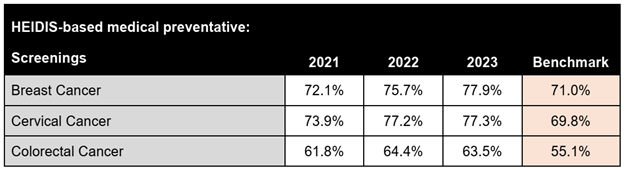
Higher screening rates results in earlier detection and coaching opportunities which thereby translate into opportunities to close gaps in care, manage chronic disease and support behavior change with the goal of a healthier employee population.
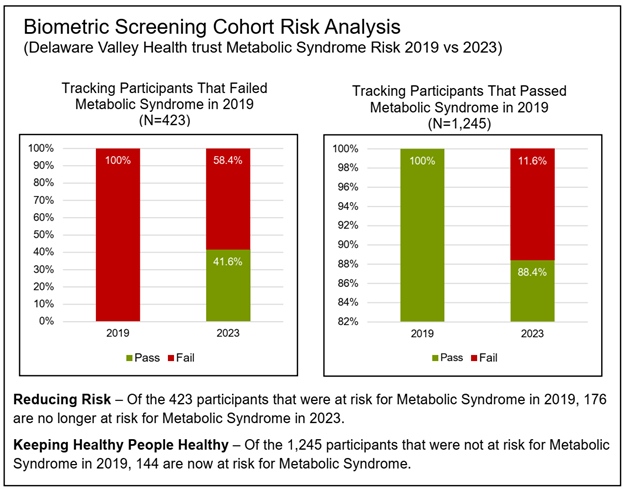
These results are just part of a wider and more robust wellness program which has succeeded in bending the health insurance cost curve for DVHT members over the past two decades.
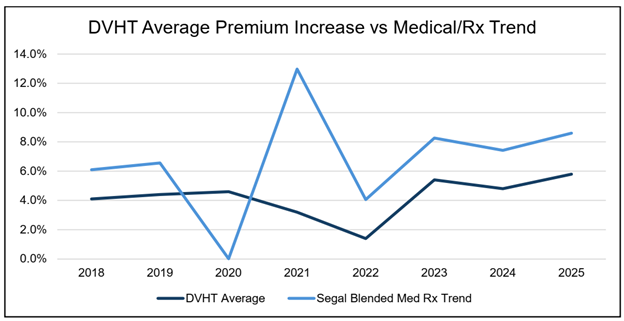
The Delaware Valley Health Trust was formed in response to rapidly rising and volatile health insurance premiums. In creating a non-profit, member-centric alternative to the existing options, DVHT has lowered costs and improved member health through a commitment to shared risk and civic responsibility.